
AAV Announces Financial Results for the Third Quarter of 2026
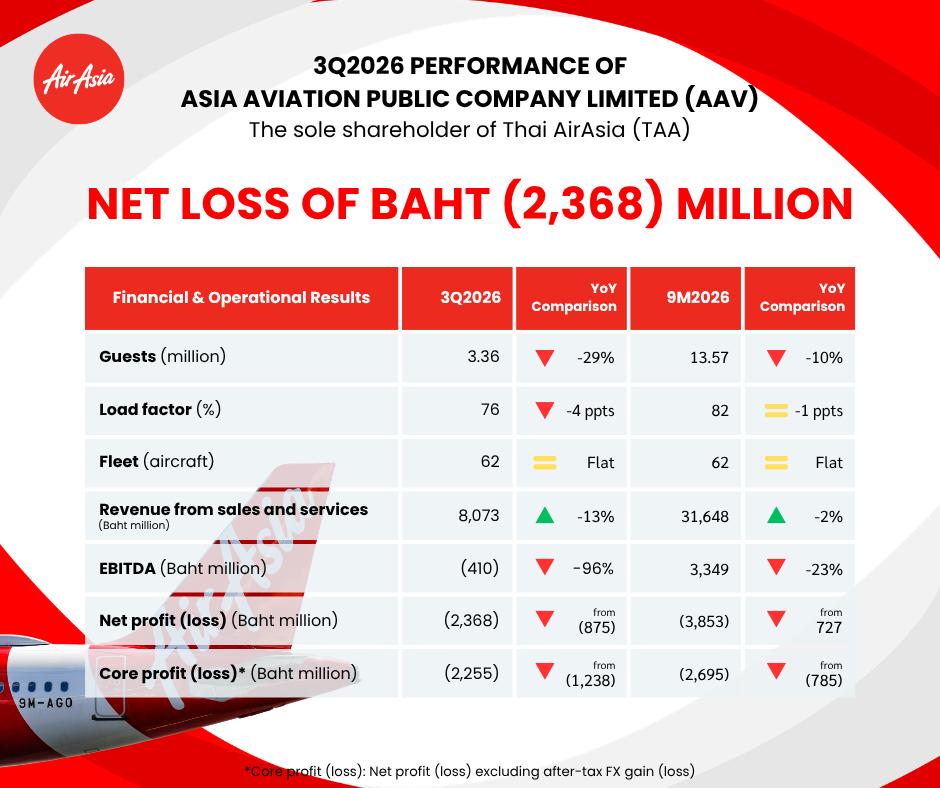
Total revenues from sales and services for the quarter stood at Baht 8,073 million, down 13% YoY, primarily reflecting intentional capacity optimizations in line with seasonal travel patterns.
Average domestic and international fares were adjusted upward to Baht 2,023 per passenger, increasing 24% YoY to help balance the dynamics of fuel and aviation costs.
Successful management of the workforce, while maintaining normal flight operations during challenging weather conditions in Bangkok reflects the airline’s operational readiness and robust business continuity planning.
AirAsia was named the “World’s Best Low-Cost Airline” by Skytrax for the 17th consecutive year.
In Q4, the airline will increase domestic flight frequencies, aiming to capture a 40% market share, while resuming services on high-potential international routes.
Bangkok, 12 November 2026 – Asia Aviation Public Company Limited (“AAV”), the parent company of Thai AirAsia (“TAA”), announced its financial and operational performance for the third quarter of 2026. The results highlight a proactive capacity management strategy to match off-peak travel demand, alongside successful pricing adjustments to navigate global jet fuel costs and improve passenger revenue metrics.
For the third quarter, revenue from sales and services stood at Baht 8,073 million, representing a 13% down year-on-year (“YoY”), which corresponded with a decreased 29% YoY in passenger volume. Concurrently, average fares increased by 24% YoY to Baht 2,023 per passenger. This equates to a Revenue per Available Seat Kilometre (RASK) of 1.96 baht, marking a strong 29% increase.
On the operating cost front, in 3Q26, Thai AirAsia provided 4.41 million seats, a 26% decrease YoY, leading to a 3% YoY reduction in the cost of sales and services. However, average jet fuel prices surged to USD 137 per barrel. Combined with aircraft maintenance and fixed depreciation costs weighed against reduced seat capacity, Cost per Available Seat Kilometre (“CASK”) rose by 40% YoY to Baht 2.50, while CASK excluding fuel (“CASK ex-fuel”) increased by 36% YoY to Baht 1.68. The company strictly controlled selling and administrative expenses, efficiently maintaining them at 8% of revenue from sales and services. Consequently, the aforementioned cost pressures resulted in an Earnings Before Interest, Taxes, Depreciation, and Amortisation (EBITDA) of Baht (410) million and a core operating loss of Baht (2,255) million. Factoring in a foreign exchange loss of Baht (141) million, the company reported a net loss of Baht (2,368) million for the quarter. To close the quarter, TAA's total fleet stood at 62 aircraft, with 42 in active operation.
Regarding the quarterly operational performance, in the domestic market, TAA carried 2.38 million passengers, a 25% decrease YoY, resulting from a 22% capacity reduction to 3.04 million seats. This was due to the temporary pause of operations at the Suvarnabhumi (BKK) hub, while successfully maintaining a domestic load factor of 78%. In the international market, passenger volume stood at 987,000, a 37% decrease YoY, following a 33% capacity reduction to 1.37 million seats. The international load factor stood at 72%. Notably, TAA resumed services to Singapore and Indonesia in this quarter following strategic pauses in the previous quarter.
For the nine-month performance of 2026 (“9M26”), AAV reported revenue from sales and services of Baht 31,648 million, a decrease of 2% YoY. TAA provided 16.57 million seats, down 9% YoY, and recorded an 82% load factor, compared to 83% in 9M25. Meanwhile, the average fare stood at Baht 1,969, reflecting proactive pricing management and capacity right-sizing to align with travel demand. On the cost side, total fuel expenses increased by 14% YoY to Baht 12,416 million. As a result, the company reported an EBITDA of Baht 3,349 million, compared to Baht 4,349 million in the same period last year, and a net loss of Baht (3,853) million, reversing from a net profit of Baht 727 million YoY. Excluding a foreign exchange loss of Baht (1,448) million, the core operating loss for 9M26 stood at Baht (2,695) million, compared to a core operating loss of Baht (785) million reported in the same period last year.
Mr. Phairat Pornpathananangoon, Chief Executive Officer of AAV and Thai AirAsia, said, “In the third quarter, the aviation business was transitioning through the off-peak travel period. Factoring in the challenges of surging global fuel prices, the company prudently executed a capacity management strategy across our fleet and network. By prioritizing the reduction of flight frequencies and temporarily pausing unprofitable routes, we redirected capacity to high-demand destinations. Nevertheless, the company maintained its top priority on service quality. This quarter, the passenger Net Promoter Score (NPS) rose to 61, exceeding our target of 50, and the airline successfully maintained a high On-Time Performance (OTP) of 90%.”
Furthermore, towards the end of the quarter, when heavy rain and flooding occurred in Bangkok, the airline received widespread commendation for successfully managing its workforce and maintaining normal flight operations. This reflects the company’s robust management and operational strength, underpinned by highly precise and flexible business continuity planning.
Looking ahead to the fourth quarter, which enters the peak travel season, the company is prepared to resume temporarily paused routes. This includes reinstating operations at the Suvarnabhumi hub for routes to Chiang Mai, Krabi, and Phuket starting this past October. The company targets reclaiming its previous domestic passenger market share level of 40%. It also plans to restore international services to key cities in India and other ASEAN destinations, alongside increasing frequencies on popular routes.
“The company anticipates that 4Q performance will build upon the results in 2Q and 3Q, with a target to deploy 54 operating aircraft in December to serve passengers during the New Year holiday. Additionally, we are adapting our strategies by designing more tailored services for specific groups, such as senior passengers aged 60 and above, who will receive dedicated check-in counters, priority baggage claim, and the ability to sit next to their companions at no extra charge. We are also collaborating with the TAT to stimulate domestic tourism through the ‘Fly Around Thailand, Heal Every Trip’ campaign, offering travelers a 500-Baht discount per booking. The campaign has received an excellent response, with discount quotas utilized rapidly,” Mr. Phairat added.
Regarding liquidity management and financial position, the company continues to see favorable developments. Furthermore, the company has prepared proactive plans to strengthen liquidity and navigate fuel cost dynamics. This includes executing aircraft sale and leaseback transactions, as well as engaging with financial institutions to access necessary funding.
Beyond operations, the company continued to elevate service standards and drive environmental, social, and governance (ESG) initiatives. AirAsia was named Skytrax’s “World’s Best Low-Cost Airline” for the 17th consecutive year and secured the “Most Sustainable Company” in Asia at the World Finance Sustainability Awards 2026, reflecting tangible success in integrating sustainability into its operations. The company also advanced ground decarbonization by piloting GUINAULT Combo Units at Don Mueang Airport to provide power and air conditioning, replacing the aircraft's Auxiliary Power Unit (APU), with full implementation beginning in September 2026. Furthermore, partnering with the Tourism Authority of Thailand (TAT) to expand the “Journey D” project into its second year, the airline engaged in post-flood recovery and community tourism promotion in Songkhla province to stimulate the grassroots economy and generate sustainable local income.